
The Impact of LAN vs Online Play on Results: Why Some Teams Disappear Without Home Ping
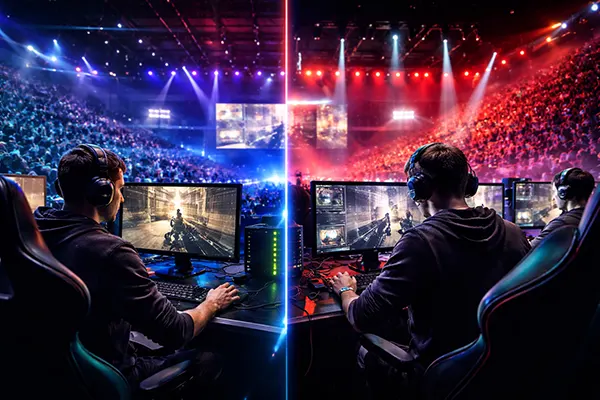
In competitive esports, performance is shaped not only by skill but also by environment. Matches played online often produce different outcomes compared to LAN events, and the gap can be significant. Over the years, analysts have noticed a recurring pattern: certain teams dominate from home setups but struggle once they step onto a stage with equalised conditions. Understanding why this happens requires looking beyond simple mechanics and into latency, psychology, communication, and structural differences between formats.
Latency and Technical Conditions: The Invisible Advantage
Online matches are heavily influenced by latency, commonly referred to as ping. Even a difference of 10–20 milliseconds can impact reaction time, hit registration, and overall consistency. Teams playing from their home environment often benefit from stable connections and familiar routing, which creates subtle but measurable advantages during critical moments.
On LAN, this advantage disappears. All players connect to the same local server with near-zero latency, removing discrepancies entirely. Actions that previously relied on slight timing buffers become fully synchronised, exposing inconsistencies in muscle memory that were unconsciously adapted to online conditions.
This shift particularly affects roles that depend on precision—such as entry fraggers in FPS titles or micro-intensive players in strategy games. A player who is accustomed to “pre-firing” based on known delay may suddenly find themselves mistiming engagements when that delay is gone.
How Ping Shapes Decision-Making and Timing
Players rarely think consciously about latency, yet it influences every action. When practising online, they adapt to the timing of their environment. This adaptation becomes ingrained, forming habits that feel natural but are technically adjusted to a specific delay.
Once on LAN, these habits can become liabilities. Timing windows shrink, reaction-based plays become more demanding, and previously safe decisions may no longer work. The player must recalibrate in real time, which is not always possible within a short tournament schedule.
Teams that consistently perform well on LAN are usually those that train under varied conditions or prioritise raw reaction discipline rather than relying on predictable latency patterns.
Psychological Pressure and Stage Environment
Another major difference lies in the psychological aspect. Online matches are typically played in controlled, familiar settings. Players sit at their own desks, use personal equipment, and communicate without external distractions. This creates a sense of comfort that stabilises performance.
LAN events introduce a completely different environment. Bright lights, audience noise, media presence, and the awareness of being watched can affect concentration. Even experienced players may feel increased stress, which impacts reaction speed and decision-making under pressure.
For some teams, especially those with less stage experience, this shift leads to hesitation. Plays that would normally be executed confidently online become slower or overly cautious, giving opponents a clear advantage.
Why Confidence Drops Without the “Home Setup”
Confidence in esports is closely tied to routine. When players lose their familiar setup—chair, monitor positioning, peripherals—they also lose a layer of comfort that supports consistent execution. Small physical differences can disrupt aim, posture, and timing.
Additionally, communication dynamics change. On stage, teammates sit side by side, but noise-cancelling headsets and crowd sound can interfere with clarity. Calls that are instant online may become delayed or misunderstood, especially during high-pressure rounds.
Teams that thrive on LAN typically have structured communication systems and mental resilience training. They rely less on comfort and more on repeatable processes that function under any conditions.

Strategic Depth and Adaptability
Online play often allows teams to rely on rehearsed strategies and predictable patterns. With limited external pressure and known conditions, these strategies can be executed with high consistency. However, this consistency can mask weaknesses in adaptability.
LAN tournaments expose these weaknesses quickly. Opponents have more time for preparation, matches carry higher stakes, and adjustments happen faster. Teams that depend heavily on set plays may struggle when those plays are countered.
Furthermore, the pace of LAN tournaments forces rapid adaptation. There is less time to analyse mistakes between matches, and teams must adjust mid-game. This demands a deeper understanding of the game rather than reliance on pre-planned scenarios.
Why Some Teams Collapse Under Equal Conditions
When all external variables are equalised, the focus shifts entirely to fundamentals: positioning, communication, and decision-making. Teams that previously benefited from online conditions lose that edge and must rely purely on core skills.
In this environment, weaknesses become visible. Poor mid-round calls, lack of flexibility, or over-reliance on individual performance can lead to rapid losses against more balanced opponents.
Successful LAN teams are those that build systems rather than shortcuts. They develop adaptable strategies, train under varied conditions, and maintain composure regardless of the setting. This is why their performance remains stable, while others struggle to replicate online success.